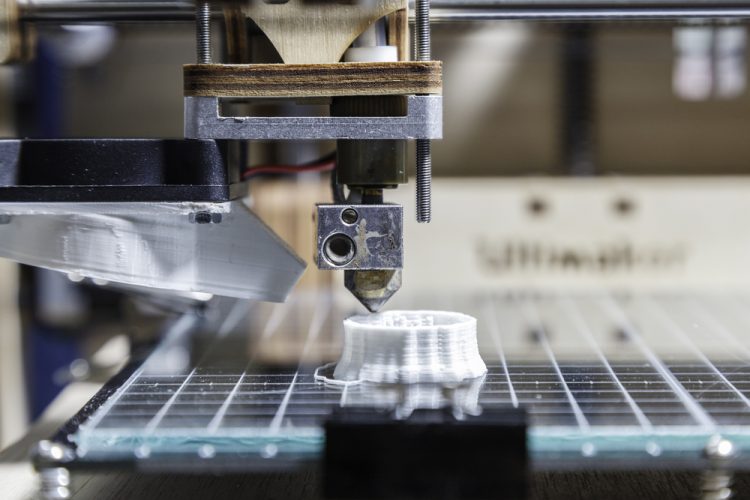
Traditional printing involves laying down an image onto a flat surface. By contrast, 3D printing deposits materials – plastic, metal, ceramic, powders, liquids or even living cells – in layers to create a three-dimensional object. It has been around for nearly three decades but how is it now transforming healthcare?
3D printing has the potential to transform the treatment of many different medical conditions, ranging from bone cancer to hearing loss. It is the foundation stone of personalised medicine, which is all about tailoring treatments to individual patients rather than developing a treatment that works well for most patients with that condition.
For example, 3D printing allows orthopaedic surgeons to print artificial bone using a scan of the patient’s body as a template. People have received skull implants for head trauma and replacement heel bones using this technique. In the future, it is likely that 3D printing will be combined with stem cell research to print living bone cells or functioning organs for transplant using the patient’s own cells.
What it is used for
3D printing has the potential to transform complex surgery and improve outcomes for patients.
Currently it is used for:
- Creating customised prosthetics and artificial implants.
- Creating individual drills, positioning templates or surgical guides in maxillofacial surgery.
- Designing individualised drugs.
- Modelling what is going on inside the patient’s body – for example aortic aneurysm – so surgeons can plan complex surgery in advance.
- Growing living tissues and organs (not yet suitable for transplantation into patients)
This is a rapidly changing technology and there are new advances happening all the time. In the future 3D printing is likely to be used for:
- Creating living tissues and organs using a patient’s own cells for transplantation into their body. This promises to reduce the wait for organ transplant and virtually eliminate the risk of rejection.
How it could help you
Although it may sound a bit futuristic, 3D printing is already a reality. It is changing the face of healthcare and has the potential to bring about many more changes in the future.
Carrothers Orthopaedics use medical 3D printing to help you by creating a customised replacement hip or knee joint that fits your body perfectly, leading to better long-term results.
Conventional joint replacement surgery uses ready-made implants. The disadvantage of this is that surgeons have to compromises on the precise fit and sizing of the implant, choosing the one that most closely matches your bone structure. If an implant does not fit perfectly, it can lead to long-term pain and restricted mobility.
One in five people who receive an off the shelf knee implant, for example are not fully satisfied with the results of surgery.
Using 3D printing, it is possible to create an implant that is a perfect, customised fit. The implant will mimic the natural shape of your joint, resulting in less pain and improved mobility.
The process can also be used to create individual drugs and surgical equipment to suit your precise internal pathology. And because surgeons can plan complex surgery in advance, you will be in surgery for less time, reducing the impact of anaesthetic on your system and improving post-surgical recovery.
What to expect
Carrothers Orthopaedics use CT scans to generate a personalised 3D model of your body.
Computer-aided design/computer-aided manufacturing (CAD/CAM) software is then used to design and produce artificial implants or surgical equipment that are completely individualised to you.
What are the risks
Because 3D printing for medical conditions is an emerging technology there are a number of issues relating to its safety and effectiveness, as well as some ethical questions that are still to be resolved.
Currently, artificial joints can be printed using materials that are already widely used in orthopaedic surgery, for example titanium. In the future, the patient’s own cells may be used to create living bone. This approach cannot be widely tested on a sample of healthy people because the treatment is designed to be specific and individualised.
Therefore, researchers will need to develop new ways of testing treatments for safety and effectiveness. This means that even if it is possible to print living tissue and organs in the near future, it is likely to be some time before such treatments are widely available.
There are also some ethical issues to consider. For example, theoretically it could be possible to enhance human capability beyond what is natural using this technology, in sports or a military context, for example.
Careful consideration will need to be given to questions like this before the treatment becomes mainstream.