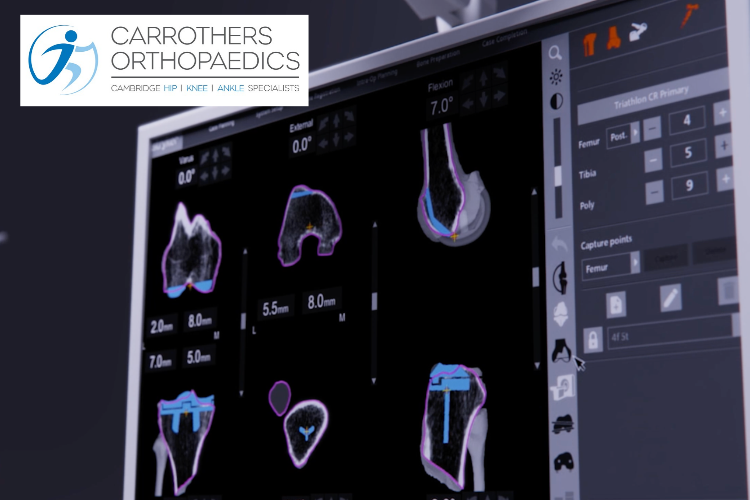
A total knee replacement is a surgical procedure to remove a damaged knee joint and replace it with an artificial knee joint, called a prosthesis. It’s called a ‘total knee replacement’ because during surgery the whole of the knee joint is replaced. By contrast, in a partial knee replacement, only the damaged compartments of the knee are replaced and some of the natural joint remains. Increasingly, orthopaedic surgeons are using the Mako system from Stryker to plan and carry out the surgery.
In this article, we’ll look at the steps involved in having a total knee replacement with Mako.
Mako – Step 1: Scan
Once you have been scheduled for a Mako total knee replacement, the first step is to have a CT scan of your damaged knee. This produces images from inside your knee joint and these are used to create a detailed 3D virtual model of your knee.
Mako – Step 2: Plan
The surgeon uses this 3D model of your unique joint anatomy to evaluate your bone structure, the severity of the damage to your knee, your joint alignment and the surrounding bone and tissue. This enables them to plan your surgery in detail before you reach the operating table. They can see which areas of healthy bone and joint can be preserved and which need to be removed and replaced. They can determine the right size, placement and alignment of knee implant to match your individual anatomy.
Mako Step 3: Surgery with Mako
Once you reach the operating table, the surgeon already has a detailed idea of what needs to happen during the procedure. During the surgery itself, they use Mako’s innovative robotic arm to guide them as they remove arthritic bone and cartilage from your knee. The robotic arm features Mako’s unique AccustopÔ technology which creates a virtual boundary between diseased bone and tissue and healthy bone and tissue.
A tactile resistance helps the surgeon to stay within the pre-defined surgical plan so that only diseased areas are removed. However, alongside this, Mako gives them real-time data so they can assess the movement and tension of your joint and adjust the surgical plan, if necessary. It is an ideal fusion of surgical skill and state-of-the-art robotic technology.
What are the benefits of Mako total knee replacement surgery?
Mako total knee replacement surgery offers a number of important benefits compared with conventional knee replacements. The detailed pre-surgical planning means that implants are precisely sized, positioned and aligned, which improves comfort and performance.
Patients often report less immediate discomfort and lower pain scores when surveyed six months after surgery compared with those who received conventional joint replacement surgery. Patients’ satisfaction scores are also generally better six months after surgery compared to conventional joint replacement patients.
AccustopÔ technology means only damaged areas of the joint are removed, preserving healthy tissue and bone. This is an important benefit if further surgery is needed in the future to replace a worn-out knee prosthesis.
It is rare to find a surgeon who possesses both extraordinary technical mastery and patient compassion, but Mr Andrew Carrothers does exactly that. Before my procedure, chronic pain completely dictated my life making walking, sleeping, and daily routines impossible. At one point, I actually lost the use of my leg and ended up in A&E, where a kind doctor informed me I needed a knee replacement. I then set out to find the best Consultant Surgeon and Mr Carrothers was definitely my first choice. As a pioneer of the Mako Robotic Arm System (which offers highly customised surgery tailored perfectly to your anatomy), he also offered both partial and full knee replacement options. I was thrilled to learn I was a potential candidate for a partial replacement. At the end of May 2026, I underwent partial knee replacement surgery. The process on the day was calm and seamless, followed by truly exceptional care at Nuffield Hospital Cambridge. My recovery is now going incredibly well. Within 4 weeks I was able to initially walk carefully without crutches post-operation, and my current status is that I continue to see improvements daily along with my tailored ongoing physiotherapy. To say I am thrilled does not describe how amazed and pleased I feel. The results have been nothing short of miraculous for me. I am looking forward to reclaiming the simple things my damaged knee took away—like a daily walk at Grafham Water with my dog. But more than that, I can now confidently reschedule a trip I postponed this year to walk the Great Wall of China next year, knowing it is now totally achievable. If you are looking for a world-class surgeon who delivers truly exceptional outcomes and can successfully restore your mobility, look no further than Mr Carrothers. I wholeheartedly recommend him for orthopaedic and especially knee surgery, and I thank him for his honest opinion, exceptional attention to detail, and dedication.
I Want Care Patient Review – July 2026
More Reviews
For more information about total knee replacements and the benefits of Mako compared with conventional knee replacement surgery, contact us.
Frequently Asked Questions
Who is total knee replacement surgery for?
A total knee replacement is for people who are experiencing severe knee pain, stiffness or loss of function due to a condition like osteoarthritis, traumatic arthritis, avascular necrosis, rheumatoid arthritis or post-traumatic arthritis. You will normally only be offered this type of surgery when other, less invasive treatment options such as painkilling medication, joint injections or bracing are no longer providing sufficient relief.
What happens after surgery?
Most patients are encouraged to stand and walk on their new knee joint soon after surgery. Typically, you will be discharged from hospital within one to two days.
Are there any risks from a total knee replacement?
A total knee replacement is a major surgical procedure and, like all forms of surgery, there is a risk of complications, including infection in the wound site or around the artificial joint itself, blood clots or nerve or blood vessel damage. Your orthopaedic surgeon will discuss the level of risk with you prior to surgery to enable you to ask questions and make an informed decision.