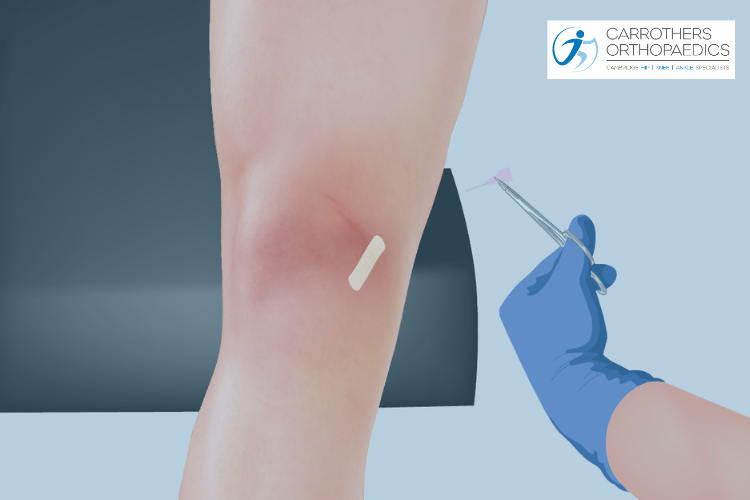
When you develop knee osteoarthritis, the cartilage in your knee joint starts to wear away and inflammatory chemicals accumulate inside the joint. The synovial membrane – the lining inside your knee joint – responds by making more synovial fluid. However, this fluid tends to be thinner and less effective than before and crystals can form inside it, speeding up cartilage loss and increasing inflammation. The joint capsule may swell and the bones may start to grind together, causing increasing pain and stiffness.
What are Arthrosamid injections?
Arthrosamid injections were developed to treat the synovium inside the knee joint, helping to provide long-lasting relief from arthritis symptoms. The injections are made from polyacrylamide hydrogel, which is largely water combined with a very small amount (2.5%) of polyacrylamide. This soft, gel-like compound combines with the natural synovial fluid inside the knee to act as an immediate lubricant and help to cushion the joint. The polyacrylamide gel integrates into the synovium and as it does not break down or degrade, creates a permanent more elastic barrier which hinders inflammatory signals from activated cells hence decreasing pain, swelling and stiffness. Through these mechanisms Arthrosamid helps to reduce pain and improve the natural function of the knee.
Other injectable treatments for arthritis symptoms
Injections are often favoured for treating mild to moderate arthritis symptoms because they are less invasive and have a lower risk of complications compared to surgery. Arthrosamid joins corticosteroids and hyaluronic acid as injectable treatments for osteoarthritis. This novel treatment technology has some clear advantages. While corticosteroid injections are an effective way of reducing inflammation in the knee joint, it can take a week or more to feel the benefits and the effects tend to be short-lived (lasting anything from a few weeks to a few months). Hyaluronic acid injections can relieve pain and stiffness for up to about six months, however, The Arthritis Foundation warns that “Hyaluronic acid injections are controversial” and it cites contradictory studies showing mixed results [1].
Research into Arthrosamid
Recent research on Arthrosamid is more encouraging. The European Society of Medicine published A Systematic Review of the Novel Compound Arthrosamid Polyacrylamide (PAAG) Hydrogel for Treatment of Knee Osteoarthritis on 18 August 2022 [2]. It explored patient reported outcome measures (PROMs) and adverse events in relation to Arthrosamid injections.
The research team carried out a comprehensive literature review of PubMed, OVID and MEDLINE databases up until April 2022. Study participants were those who’d received PAAG hydrogel injections for knee osteoarthritis. A total of 463 patients’ outcomes were reported and assessed, and statistically significant data was identified in two studies at both 52 weeks and 13 months. These showed the efficiency of PAAG hydrogel injections one year after being administered. Further continuation of one of these studies showed statistically significant results two years after the injection was administered. In another randomised controlled trial, numerically superior data was identified compared to hyaluronic acid injections. The researchers concluded “From the literature, this PAAG hydrogel seems to be an effective and safe treatment option for knee OA [osteoarthritis] and provides positive results for at least two years.”
Arthrosamid is a relative newcomer in the injectable treatment of osteoarthritis and another randomised controlled trial published in September 2024 [3] set out to assess the “non-inferiority of intra-articular injectable polyacrylamide hydrogel (iPAAG) to hyaluronic acid on symptomatic benefit in individuals with knee osteoarthritis.” In other words, the researchers were interested to find out whether this novel form of injectable treatment was as effective as more established treatments.
They considered 239 randomised adults using the WOMAC pain scale (the Western Ontario and McMaster Universities Osteoarthritis pain scale which uses a self-administered questionnaire to assess knee or hip pain). The researchers concluded “iPAAG was found to be as effective and safe as HA [hyaluronic acid injections] for treatment of knee OA [osteoarthritis] symptoms for at least 1 year after a single injection.”
Where to find out more about Arthrosamid
Arthrosamid is just one of a range of treatments for knee pain. We have plenty of information on our website and our blog. If you would like to discuss treatment options for mild to moderate arthritis as well as more severe symptoms, contact us.

Talk to an orthopaedic consultant | Cambridge
We are always happy to provide information and guidance about the various treatment options, both surgical and non-surgical, including Mako Robotic Arm Assisted Surgery and conventional surgery.
For more information, please contact us.
Our consultation fees are clearly presented here.
For your convenience, we offer appointments at both Nuffield Hospital Cambridge and Spire Cambridge Lea Hospital.
Sources
[1] https://www.arthritis.org/health-wellness/treatment/treatment-plan/disease-management/hyaluronic-acid-injections-for-knee-pain